




The UGV that launches a drone on demand – how slide out drone deployment is changing ground operations by using heavy duty telescopic slides
Unmanned ground vehicles have always been defined by what they can do on the ground. But a rapidly growing class of UGV is rewriting that definition by carrying a drone inside the vehicle and deploying it on demand, from the field, without human intervention at the point of launch.
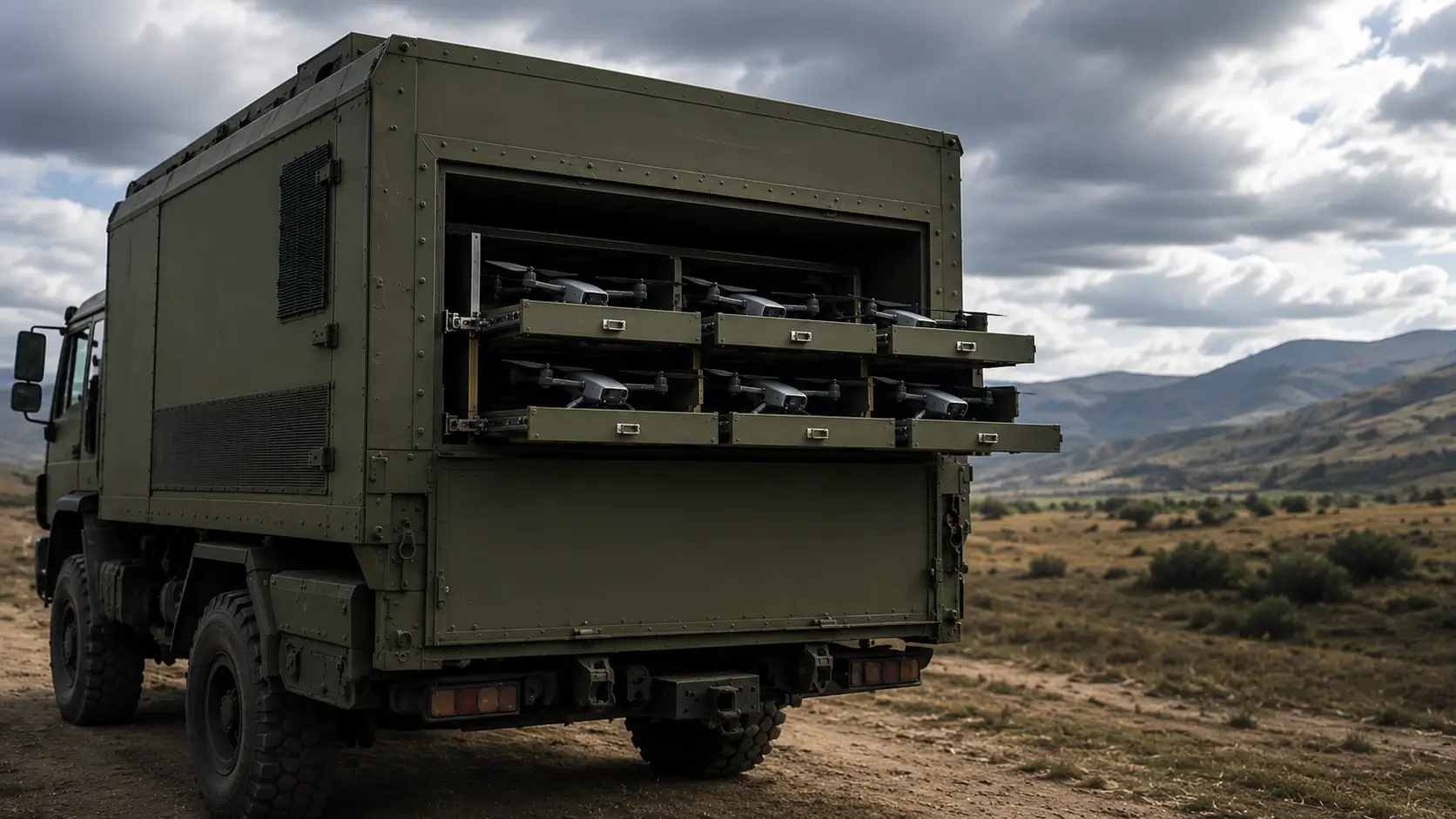
The concept is straightforward: a UGV moves into position, a drone slides out from within the chassis on a precision deployment mechanism, takes off autonomously or on command, completes its aerial mission, returns, and is retracted back into the vehicle. The ground team never needs to expose themselves. The drone is protected during transit, deployed when needed, and recovered safely.
This is not a prototype concept. It is an operational capability being fielded now and the slide-out drone deployment mechanism at the heart of it depends on hardware that is far more demanding than it looks: heavy-duty telescopic slides including full extension cold drawn slides, ball bearing slides, and crossed roller bearing slides built to survive the same harsh environments the UGV itself operates in. At Sliding Systems, we supply precisely these components to UGV manufacturers and defence contractors worldwide.
What is a UGV with Integrated Drone Deployment?
The Concept Explained
A drone-deploying UGV is an unmanned ground vehicle that carries one or more drones typically quadcopters or fixed-wing UAVs within a protected bay in the vehicle body. When a drone is required, it is extended out of the vehicle on a sliding platform, cleared for take-off, and launched. On return, the drone lands on the same platform, which retracts back into the protected bay.
This gives the combined system capabilities that neither platform has alone:
- The UGV provides ground mobility, payload capacity, power generation, and communications infrastructure
- The drone provides aerial reconnaissance, surveillance, or strike capability that the UGV cannot achieve from ground level
- Together, they create a multi-domain autonomous system that operates across ground and air without requiring human presence at the point of operation
Why Not Just Carry the Drone and Deploy It Manually?
Manual drone deployment from a vehicle is already common but this approach has significant limitations in the environments where UGVs are most valuable:
- It requires human personnel to be physically present at the forward deployment point
- It exposes operators in environments that may be hostile, contaminated, or otherwise dangerous
- It is slow manual assembly, pre-flight checks, and launch take time that may not be available
- It is not repeatable autonomously a human must be present for every deployment and recovery cycle
An integrated slide-out system solves all of these problems. The drone is pre-positioned, protected, and ready. Deployment can be commanded remotely or triggered autonomously. No human needs to be anywhere near the vehicle.
Where is this capability being used?
Military and Defence operations
The military applications are immediately apparent. A UGV operating in a contested environment can advance to a position that would be too dangerous for personnel, then deploy a drone for real-time aerial intelligence – combining ground and air reconnaissance in a single autonomous system.
Specific military use cases include:
- Forward reconnaissance the UGV moves to a position of cover, deploys a drone to survey terrain ahead, then retracts the drone and advances based on the intelligence gathered
- Perimeter and area surveillance a static UGV deploys a drone on a repeating surveillance cycle, providing persistent aerial coverage without continuous human oversight
- Target acquisition and designation positioning the drone for precision observation or laser designation from an aerial vantage point the UGV cannot access
- Post-engagement assessment deploying a drone to assess the situation before ground forces are committed
- Counter-UAS operations deploying a pursuit or detection drone in response to a detected aerial threat

Search and Rescue
In search and rescue, the slide-out drone UGV addresses one of the discipline’s most persistent challenges: getting aerial eyes into environments inaccessible to manned aircraft and too dangerous for ground teams. A UGV equipped with a slide-out drone can advance into a collapsed building, flood zone, or wildfire perimeter, then deploy a drone to survey areas that even the UGV itself cannot enter.
Industrial Inspection and Infrastructure
In the energy, utilities, and infrastructure sectors, UGVs are increasingly used for inspection of hazardous facilities. Adding a slide-out drone creates a combined inspection system that surveys both ground-level and aerial infrastructure in a single deployment a UGV patrolling a solar farm can deploy a drone to inspect elevated panel rows, while in a pipeline corridor the drone checks aerial crossings and elevated spans.
Industrial Inspection and Infrastructure
A UGV with a slide-out drone creates a mobile surveillance asset that responds dynamically to detected activity moving to a position and deploying a drone for immediate aerial coverage of a target area, without the fixed infrastructure cost or predictable patrol pattern of static systems.
The Slide-Out Mechanism – Why It Is the Critical Component
What the Mechanism Has to Do
The slide-out drone deployment mechanism sounds simple in concept. In practice, it is one of the most demanding mechanical systems on the vehicle. It must:
- Support the full weight of the drone at complete extension rated loads at full over extension travel, without deflection that would misalign the drone for launch
- Extend and retract smoothly and repeatably across thousands of deployment cycles, in temperatures from -40°C to +85°C
- Resist shock and vibration during vehicle transit UGVs do not travel on smooth roads, and the drone bay is subject to constant mechanical stress during movement
- Remain sealed and protected when retracted the drone is a sensitive, expensive asset that must be protected from dust, mud, water, and physical damage during transit
- Operate reliably in contaminated environments salt spray, chemical exposure, sand, and mud are routine in these deployments
- Complete the deployment and recovery cycle fast tactical scenarios may require drone deployment in seconds, not minutes
- Function without human intervention the mechanism must be fully remotely operable, with no manual steps required at the vehicle
Why Standard Slides Fail in This Application
Commercial-grade telescopic slides, the type used in server racks, industrial cabinets, or equipment drawers are not designed for the loads, the environmental conditions, or the operational cycle life that a UGV drone deployment system demands.
A slide that jams with the drone extended leaves it exposed and potentially unusable. A slide that fails to retract means the drone cannot be protected during transit. A slide that loses its load rating under shock loading can drop the drone. In a military deployment, any of these failures can compromise the mission. The choice of slide materials is equally critical standard steel corrodes rapidly in salt-spray environments, while inadequate aluminium alloys fail under repeated shock loads.
Heavy-Duty Telescopic Slides from Sliding Systems – Built for This Environment
At Sliding Systems we manufacture and supply heavy-duty telescopic slides specifically engineered for demanding military, defence, and harsh-environment applications. Our heavy duty telescopic slides include full extension slides, container slides, and crossed roller bearings are used in UGV drone deployment mechanisms because they are designed to the specification those environments demand, not adapted from a lighter-duty product.
Full Extensions Slides
Full extension slides are the primary configuration for drone deployment platforms. Unlike partial-extension designs, full extension slides allow the drone platform to travel the complete length of the slide body ensuring that the drone clears the vehicle chassis entirely before launch. This is non-negotiable: a drone that cannot clear the vehicle body cannot launch safely.
Ball Bearing Slides
Ball bearing slides are the preferred choice wherever smooth, repeatable, low-friction operation is required across temperature extremes. The ball bearing race between inner and outer rail members provides consistent travel without the stick-slip behaviour of plain bearing designs critical for autonomous deployment systems where position accuracy matters and where stiffened slides in cold conditions cannot be tolerated.
Sliding Systems ball bearing slides are available with sealed bearing races and low-temperature-rated lubricants for operation down to -40°C. The sealed design prevents ingress of dust and contamination during transit, maintaining consistent performance throughout the operational life of the system.
Slide Materials
The choice of slide materials is one of the most significant engineering decisions in a UGV drone deployment system. At Sliding Systems, we offer slides in:
- Stainless steel maximum corrosion resistance for salt-spray, chemical, and maritime environments. The preferred material for naval and coastal deployments
- Hard-anodised aluminium significant weight saving over steel with excellent corrosion resistance and surface hardness. The preferred material for weight-sensitive airborne or rapidly-deployable platforms
- Zinc-plated and passivated steel cost-effective corrosion protection for land-based deployments where weight and extreme corrosion resistance are less critical
Material selection is matched to the specific environmental specification of each programme
Over Extension
Over extension – travel beyond 100% of the closed length – is available in selected telescopic slide configurations and is particularly relevant for UGV drone deployment applications where the drone must be positioned further from the vehicle than a standard full-extension design permits. Over extension slides allow the drone platform to travel up to 150% or more of the rail body length, providing additional clearance for large drone footprints or for deployment in narrow vehicle configurations where the drone bay is positioned deep within the chassis. Take a look at our super extension range of slides for more information.

Key Characteristics for UGV Drone Deployment Applications
All Sliding Systems heavy-duty telescopic slides for UGV applications are specified to include:
- Full-extension load rating rated for specified loads at full extension, not at mid-travel. Critical where the platform is cantilevered during launch and recovery
- MIL-STD-810 environmental compliance designed and tested to military standards covering shock, vibration, temperature extremes, humidity, salt fog, and dust
- High-cycle life engineered for thousands of deployment cycles without degradation in load rating or smoothness
- Positive locking in retracted position preventing the platform from extending under shock loading during vehicle transit
- Positive detent at full extension holding the platform stable during drone launch and recovery without a separate locking step
- Low-friction operation at temperature extremes ball bearing systems and lubricants selected for consistent performance across the full operating range
- Field-serviceable design accessible regrease points and design for maintenance with gloved hands in field conditions
Customisation for OEM Integration
No two UGV drone deployment systems are identical. Chassis dimensions, drone weight and footprint, deployment direction, actuation method, and environmental specification all vary between platforms and programmes. The engineering team at Sliding Systems works directly with UGV manufacturers and system integrators from early design through to programme-of-record production, offering:
- Application engineering support specifying the right slide configuration full extension, ball bearing, container slide, over extension for each platform’s unique requirements
- Custom slide configurations modified rail profiles, non-standard travel lengths, integrated locking mechanisms, and custom surface treatments
- Prototype and low-volume supply supporting development and trials phases with rapid-delivery stock
- Production volume supply scaling to programme-of-record quantities with consistent quality and traceability
Frequently Asked Questions
It is an unmanned ground vehicle that carries one or more drones within a protected bay in the vehicle body. When aerial capability is required, a slide-out mechanism typically based on heavy-duty full extension slides or ball bearing slides extends the drone platform clear of the vehicle, allowing the drone to take off, complete its mission, return, and be retracted back into the protected bay. The entire sequence can be executed remotely or autonomously, without requiring human presence at the vehicle.
The combined UGV-drone system supports a wide range of missions across military, security, search and rescue, and industrial sectors. In military applications, it enables forward reconnaissance, perimeter surveillance, target acquisition, and post-engagement assessment without exposing personnel. In search and rescue, it allows aerial survey of areas inaccessible to ground teams. In industrial inspection, it provides both ground-level and aerial survey capability in a single deployment.
The drone deployment platform is typically extended on heavy-duty telescopic slides most commonly full extension slides with ball bearing inner races for smooth, low-friction travel at temperature extremes. In some UGV configurations, container slides are the appropriate architecture, integrating with a hardened drone bay. Over extension configurations are available where the drone must clear the vehicle by a greater margin than standard full extension permits. The choice of slide materials stainless steel, hard-anodised aluminium, or zinc-plated steel is matched to the environmental specification.
Many slide-out drone deployment systems include an integrated charging connection on the drone platform that engages automatically when the slide returns to the home position. This allows the UGV’s power system to recharge the drone between deployments, enabling multiple drone sorties from a single UGV deployment.
Well-engineered slide-out mechanisms can complete the extension sequence – from bay opening to drone-ready-for-launch in a matter of seconds. Recovery typically takes slightly longer to allow safe power-down. The mechanical quality of the telescopic slide is a key factor: a high-quality ball bearing slide with consistent low-friction operation will perform faster and more repeatably than a lower-specification slide that degrades over time or stiffens in cold conditions.
Standard commercial telescopic slides are designed for controlled, stable environments they are not full extension slides rated at full travel, are not built with the ball bearing systems needed for reliable cold-temperature operation, and are not manufactured from the slide materials required to survive salt spray and chemical exposure. They are also not rated for the loads at over extension that many UGV drone deployment geometries impose. A standard slide will lose its load rating, corrode, or seize potentially stranding the drone in the extended position or dropping it during deployment. Heavy-duty telescopic slides from Sliding Systems built to military specification are the only appropriate choice.
Why The Hardware Must Match the Mission
The integration of slide-out drone deployment into unmanned ground vehicles represents one of the most significant advances in autonomous systems in recent years. It transforms the UGV from a ground-bound platform into a multi-domain system that can surveil and operate in three dimensions — without any human presence at the point of operation.
Enabling technology is not just the drone. It is not just the autonomy software. It is the mechanical system that gets the drone safely out of the vehicle and back again, every time, in any condition.
Heavy-duty telescopic slides – full extension slides, ball bearing slides, container slides, and over extension configurations in the right slide materials engineered for military specification and built for thousands of operational cycles in the harshest environments on earth are the component that makes this possible.
If you are designing, integrating, or procuring a UGV with drone deployment capability and need a slide system you can rely on, contact info@gsfslides.com

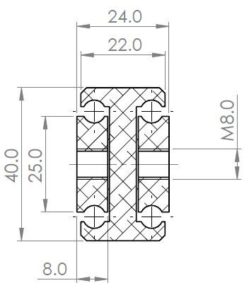 4015.ADTS040 – ADTS-40